
• Skip to main content

Sarah L. Kaufman

Author of Verb Your Enthusiasm & The Art of Grace

  • Home
  • Books
    • Verb Your Enthusiasm
    • The Art of Grace
      • About the Book
      • Excerpt
      • Blog
  • Bio
  • Writing
  • Events
  • Contact

Blog

You Got One More Gear

August 10, 2015 By Sarah Kaufman

Tires_vintage_art_01

I fixed my eye on the kid up the road. He was my son, a recent high-school grad and competitive cyclist, and he was waiting for me with a big smile as I churned toward him on a mountain bike in North Carolina’s Pisgah Forest.

“Hey Mom, you got one more gear,” he said in surprise as I arrived. I looked down at my chain ring and saw he was right: I could have shifted into easier pedaling. But though the climb was steep I hadn’t felt I needed it–I’d been so focused on that smile of his, a magnet of encouragement.

We continued riding, side by side, but darn if the mountain wasn’t growing, rising up around every turn bigger and beastlier than before. Now I was absolutely in my easiest gear, but it wasn’t enough. I had to stop.

“C’mon, Mom!” my son called back to me, his grin a bright spot of light in the forest shade. “Drink some water, Mom! Get back on, Mom; you got this!”

Uh, really? I thought. But his perkiness and the sparkle in his eye moved me back onto the saddle. And when I started pedaling again I had that feeling from before, like I had one more gear–even though I didn’t. Somehow I felt I had a little reserve in the tank; I wasn’t yet running on empty. I had just enough to keep going.

Encouragement, inspiration, awe: These are all powerful forces. Curiously, they’re rarely studied by scientists and academics. They’re difficult to document with data points. But we know them when we feel them.  They ease and lubricate our efforts, they get us through hard times. Any athlete or weekend 5K-er knows that cheering from the sidelines helps fire up the will. In any setting, joyfully given support (joyful is the operative word!) can offer a lift. And along with the wave of optimism blowing your way, you might feel a little awe at yourself, too. How’d I manage to motor on? That’s a pretty nice gift.

Awe can arise from a moment of human lovingkindness just as it can from nature, beauty or a religious context. An interesting New York University study –a rare one to address this topic–shows that experiencing awe can make us happier, less stressed, even more creative. To which I’ll add: especially when you stumble upon awe in a surprising place, like when a thigh-burning test in the woods is sweetened by a bright-eyed teen.

Those with the kindness and compassion to inspire awe are truly graceful. They transform a tough time into a moment of grace. They are that one more gear, which eases our efforts and gives us elegance when we least expect it. 

Perhaps you’ve had an experience like this. Who’s your “one more gear”?
Filed Under: Uncategorized Tagged With: art of grace, awe, encouragement, grace, inspiration, pisgah, sarah kaufman, sarah l. kaufman

Leap Into Grace

August 7, 2015 By Sarah Kaufman

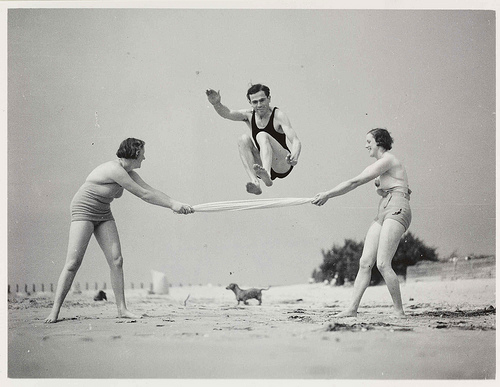
exercising on the beach

Here’s what I believe about grace:

Grace is part of the human condition. Let’s own it.

Grace, as poets and philosophers have pointed out for centuries, is part of beauty. Some feel it’s more important than beauty. “Beauty without grace is the hook without the bait,” wrote Ralph Waldo Emerson. When we think of beauty, we tend to focus on static qualities of appearance. Grace, however, is beauty in action, whether we’re talking about grace as a spiritual quality, as welcoming behavior, or as a smooth and harmonious way of moving.

Graceful movement is perhaps the most underrated of the three types of grace; religious grace or “the social graces” may spring to mind first. But think about movement for a moment. How does it happen? There is so much mystery to movement, which is part of its enchantment. No one really understands how we move, how we manage to get all our parts organized to brush our teeth or take out the trash or play tennis without thinking much about each moment. The mechanisms by which our brains orchestrate movement and get our bodies out into the world–which is at the very core of our evolutionary mandate–remain obscure. They’re simply too complicated to study with the available brain-scanning technology. Talk to neuroscientists and you’ll hear how awestruck they are by the secret choreography of our 100 billion brain cells, all working together to produce coordinated motion.

Here’s one of my favorite TED talks, by neuroscientist Daniel Wolpert, a self-described “movement chauvinist.” He’s funny and wise, and addresses this very subject. His talk is called “The Real Reason for Brains.”

Robots can beat us at chess but they cannot approach the ease of ordinary human motion. Breaking down the miracle of movement is beyond the reach of science, but there is not much mystery to how we can become even better, more graceful movers. It’s pretty simple: Practice. “Grace is the growth of habit,” wrote eighteenth-century French moralist Joseph Joubert. “This charming quality requires practice if it is to become lasting.”

Grace is an habitual practice, which involves and enhances the whole person. Getting up and moving is the only way we’ll move better, and more gracefully. Personally, I think it’s more appealing to view moving as a route to being graceful, rather than as a chore to labor through in order to burn calories or get fit.

It’s important to find a physical activity you truly love. For me, it’s swimming; I’m in the pool every weekday morning. And every morning it feels like a miracle. I never learned to swim as a kid, so some years ago I signed up for a swim class for adults. I expected to be the only awkward mom amid a bunch of teenagers–but the class was full of other folks just like me. I’ll never forget the first time I swam a full length, emerging to clutch the wall in the deep end, gasping and amazed.

That’s pretty much how I feel after every swim, decades later: awash in wonder. The flopping-around, sinking, sputtering little girl in me cannot believe I can get back and forth across the pool. 

That bone-deep, full-body, physical deliciousness can come from anywhere: from a long walk through your neighborhood, a run, a bike ride, a hike. The joy of moving is unlike anything else, don’t you find? Health-wise, we tend to place a lot of emphasis on eating right and going organic and cutting out carbs and junk–and those are all important. But getting out in the world and simply moving? That’s the best thing you can do for yourself. As Daniel Wolpert says, We have a brain so we can move. And moving is crucial for our brains. Numerous studies show walking helps you think, and that it may help slow the progress of Alzheimer’s. Students do better on exams after 20 minutes of exercise. 

Moving does all that, and enhances our gracefulness too. Walking to the post office or the library, taking the stairs, enjoying a good, long stroll at lunch–there are so many ways to move with increasing ease and grace through your day.

Moving feels good for a reason: We are meant to do it. We are meant to do it so much that we become expert–and graceful-movers. Our brains and our bodies are designed for grace.

How about you? Do you have a favorite way to put movement into your day?

photo credit: “Exercising on the Beach” via http://photopin.com 

Filed Under: Uncategorized Tagged With: alzheimer's, art of grace, daniel wolpert, grace, ralph emerson, sarah kaufman

  • « Go to Previous Page
  • Page 1
  • Page 2
  • Page 3

Copyright © 2025 Sarah L. Kaufman · Site design: Ilsa Brink · FOLLOW SARAH ON: