• Skip to main content

Sarah L. Kaufman

Author of Verb Your Enthusiasm & The Art of Grace

  • Home
  • Books
    • Verb Your Enthusiasm
    • The Art of Grace
      • About the Book
      • Excerpt
      • The Art of Grace Blog
  • Bio
  • Writing
  • Events
  • Contact

Uncategorized

“The Peace of Wild Things”

February 23, 2016 By Sarah Kaufman

nighsky

My friend Rose sent me a poem titled “The Peace of Wild Things,” which was given to her by a bereavement counselor. The poet is Wendell Berry, a beautiful and prolific writer with deep ties to the land. Born in 1934, he has worked his Kentucky farm for most of his life. I love this poem’s meditation on the stillness and acceptance of the natural world. As Rose pointed out, the line about nature’s creatures “not being taxed by forethought of grief” reminds us that instead of worrying about what’s to come, we can enjoy the present moment instead. I find these words so consoling, especially the ending, that sense of a great soft power simply waiting, waiting, patiently watching as time and pain wash over us, and wash past. I’ve excerpted just a few lines below out of respect for his copyright, but you can read the full poem here:

From “The Peace of Wild Things”
BY WENDELL BERRY

“I come into the peace of wild things
who do not tax their lives with forethought
of grief. …
And I feel above me the day-blind stars
waiting with their light. For a time
I rest in the grace of the world, and am free.”

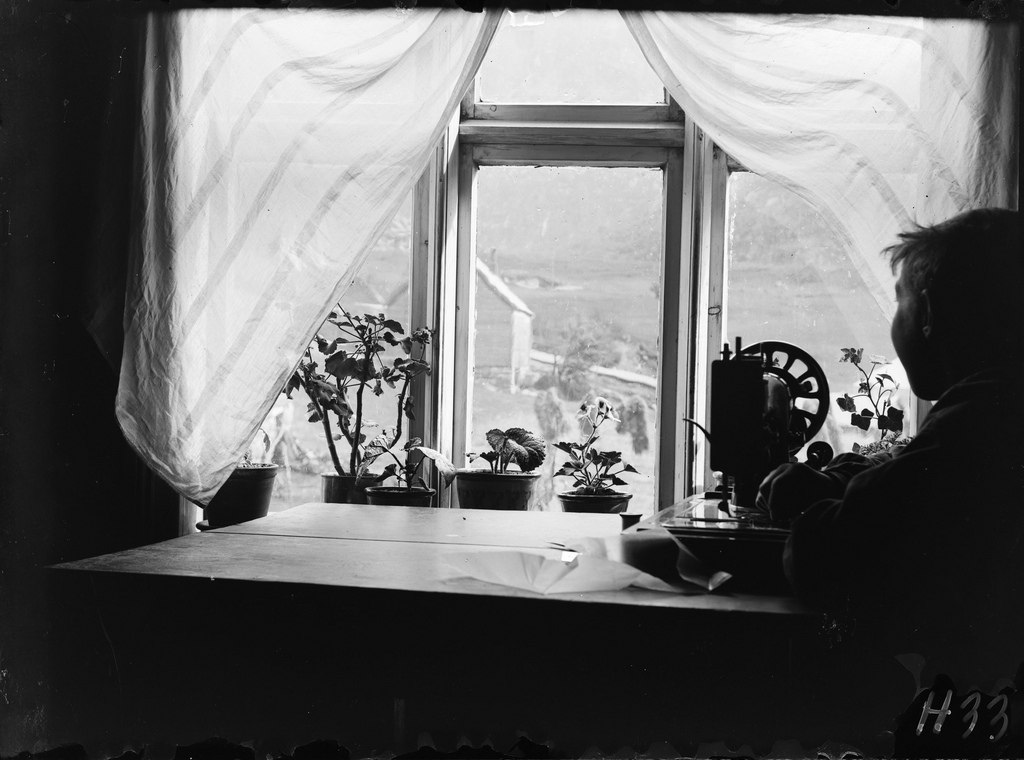
Flickr Commons photo, from the book “In God’s out-of-doors” (1902) by William A. Quayle.
Filed Under: Uncategorized Tagged With: kaufman book, kaufman dance, kaufman grace, sarah kaufman, sarah l. kaufman, wendell berry

Cary Grant & Bobby Kennedy: Two Gentlemen of the Junkyard

February 20, 2016 By Sarah Kaufman

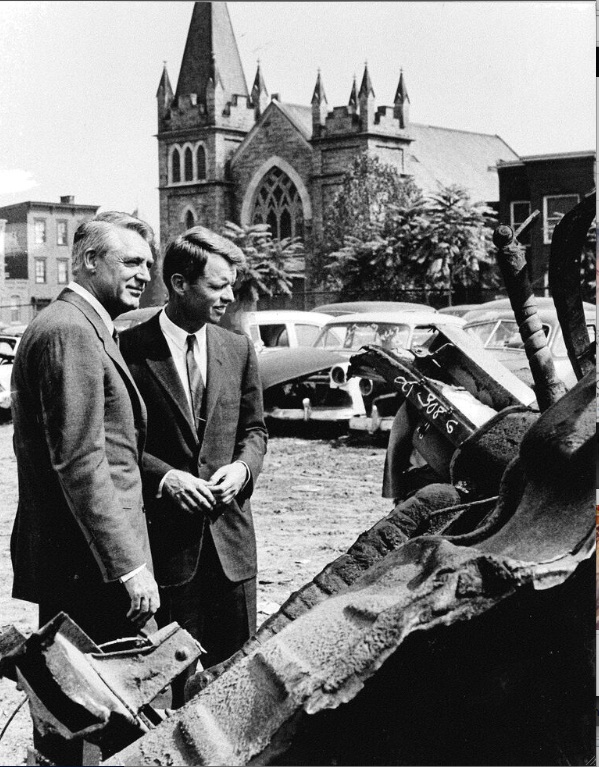
Cary Grant and Robert F. Kennedy. © 1963, Bob Burchette/The Washington Post. Used with permission
Cary Grant and Robert F. Kennedy. ©1963, Bob Burchette/The Washington Post. Used with permission

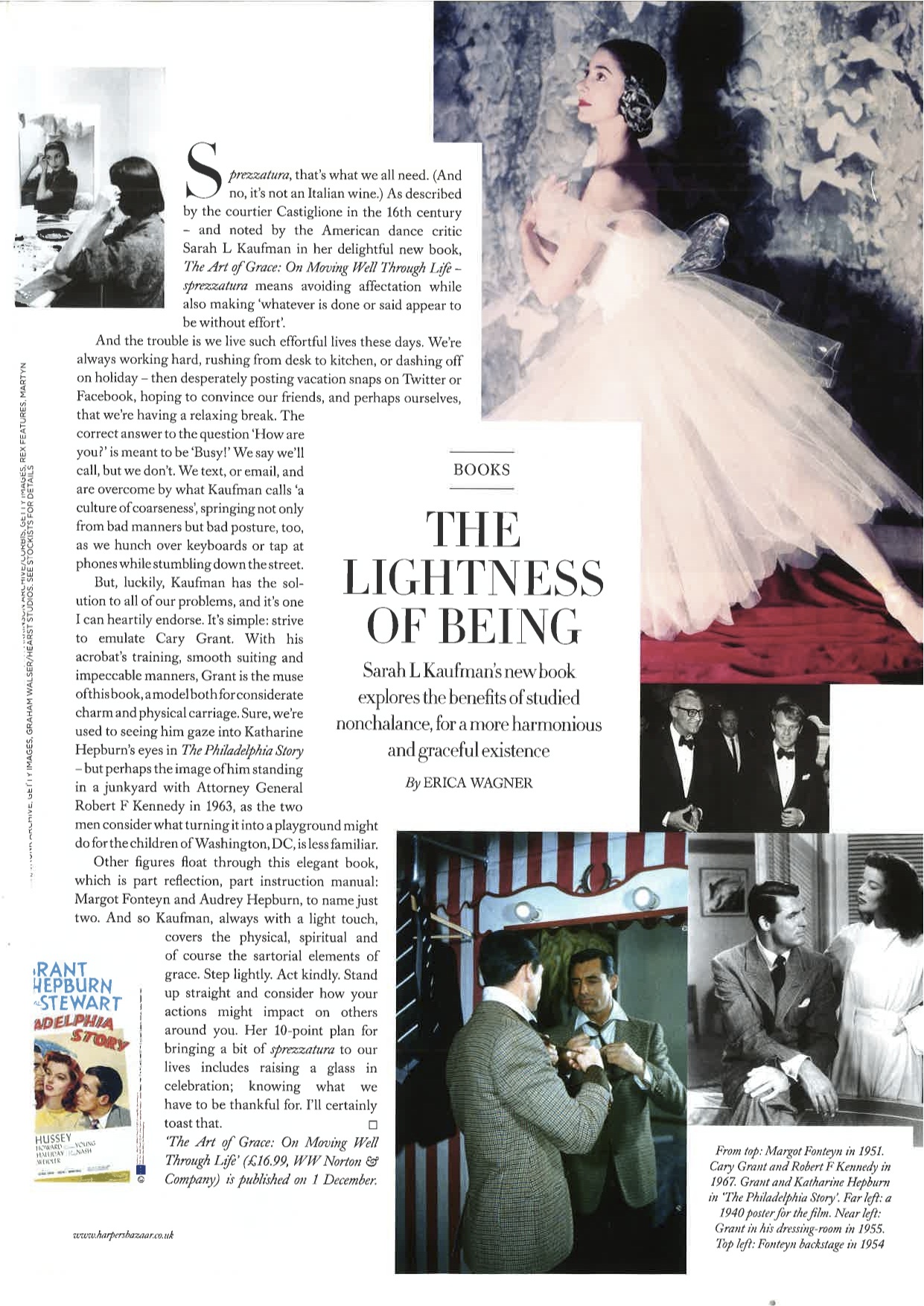
A beautiful spread in the British Harper’s Bazaar about THE ART OF GRACE is very dear to me, and not only for its wonderfully kind descriptions (“delightful,” “elegant,” “always with a light touch…” oh, I could go on!). The writer, Literary Editor Erica Wagner, also takes note of one of the photos in the book, and she highlights its meaning.

It happens to be one of my favorite photos of the book, depicting the actor Cary Grant and Attorney General Robert F. Kennedy standing together in an impound lot. In her review, Wagner notes Grant’s “considerate charm and physical carriage,” and also this extra dimension of his caring nature: “Sure, we’re used to seeing him staring into Katharine Hepburn’s eyes in ‘The Philadelphia Story’–but perhaps the image of him standing in a junkyard with Attorney General Robert F. Kennedy in 1963, as the two men consider what turning it into a playground might do for the children of Washington, DC, is less familiar.”

I found the photo in question hidden in the archives at The Washington Post, unseen for decades, its edges curling, and my heart gave a little leap, for it perfectly illustrates an altogether different, off-screen view of Grant. It underscores why the debonair actor is a guiding spirit in my book.

The Harper’s review (please click on it to enlarge):

The Art of Grace, Harper's Bazaar, December 2015

Filed Under: Uncategorized Tagged With: art of grace, bobby kennedy, cary grant, grace, robert kennedy, sarah kaufman, sarah kaufman author, sarah kaufman grace, sarah kaufman washington post

The grace of Ginger Rogers

December 20, 2015 By Sarah Kaufman

Ginger Rogers, 1965, "Hello Dolly." Photo by Stanley Wolfson, World Telegram & Sun
Ginger Rogers, 1965, “Hello Dolly.” Photo by Stanley Wolfson, World Telegram & Sun

This is one of my favorite photos of Ginger Rogers. It conveys so much about her warmth and generosity, her elegant bearing, her connection to a live audience–her grace.

In this photo she’s taking a curtain call from “Hello Dolly,” on Broadway, and we can imagine that in her beautiful gesture of outreach and gratitude she’s drawing on her years of experience on the vaudeville stage, where she started out in her youth, well before her film career.

From my chapter “Working at Grace: Lessons from Vaudeville,” in THE ART OF GRACE: “Rogers is one of the most graceful creatures of any category. She danced with an emotional responsiveness you rarely see in any dancer, film or otherwise. This is what made her the perfect oil for Fred Astaire, the cool perfectionist. Rogers deepened the drama as she danced, with the way she reacted to him with her body and her eyes. That responsiveness is also there in the scenes where she is simply listening. But she not only learned how to dance, sing, and act on the vaudeville circuit, she developed an enduring levelheadedness and work ethic that carried her through seventy-three films and were just prized in a Hollywood of fragile egos and high-maintenance insecurities. That’s grace, too, because it makes things easier for everybody else.”

Here’s a little-known story about Rogers and her openness: She commissioned a bust from the Japanese American artist Isamu Noguchi, one of the most important artists of the 20th century, and they worked together on it after the Japanese bombing of Pearl Harbor, in the face of nationwide antipathy toward the Japanese. According to Rogers’ biography, it happened to be Dec. 7, 1941 — the day of the Pearl Harbor attack — when she got word that Noguchi was willing to sculpt her. The next day, as the nation was roiling with grief and hatred of the Japanese, Rogers invited Noguchi to her home. She eventually built a studio in her house where he began working on the commission.

But Noguchi’s work on the piece was interrupted. As the government began rounding up people of Japanese heritage to send them to internment camps, he volunteered to join them. It was from one such camp in the Arizona desert that he completed her bust. Despite the climate surrounding her, Rogers never wavered in her support of the great artist. It’s a touching story, which I wrote about for The Washington Post when letters between Noguchi and Rogers went on display alongside the bust at the National Portrait Gallery in Washington, D.C. You can read my story here: How Ginger Rogers and Isamu Noguchi worked together.

Filed Under: Uncategorized

From My Great-Grandmother’s Table, the Secrets of Life

November 25, 2015 By Sarah Kaufman

dining room table blog pic
When my family sits down to Thanksgiving dinner tomorrow, we’ll gather in a rather modest dining room dominated by an immodest table. It’s a broad, sprawling Queen Anne reproduction with a deep mahogany finish. It belonged to my great-grandmother Mildred Holt, who at age 105 became Johnny Carson’s oldest guest. I write about her and Carson in my book, The Art of Grace. Like everything else about Mimi, as we called her, the table is expansive and adaptable. With five leaves in it, it nearly extends into my living room.

Normally, we keep it in a small round, no leaves, but for special occasions, where we might seat 14 or 15, we unfold it in all its scarred, somewhat rickety glory. This is how Mimi kept it in her home in Kansas.

Mimi was born in the tiny town of Ellsworth in 1882, the youngest girl of 10 children. Her father was a Civil War veteran. She lost her mother at 10; she lived through the Dust Bowl and the Depression. That’s when her banker husband lost his business. But as the very soul of self-sufficiency, Mimi put her big table and small kitchen to good use. It was around that great table–which she bought on her honeymoon in 1905–that her high spirits and natural grace came into full flower. Starting in the 1930s, when money was tight, Mimi supported her family by taking in boarders and running a tearoom in her home, serving meals to schoolteachers and workmen in her dining room.
https://www.youtube.com/watch?v=U4EI2fvi_xk
When a new highway diverted traffic away from Ellsworth, the town’s two hotels shut down. After that, the only place you could get “a meal you could be proud of,” as my mother put it, was Mimi’s tea room. Mimi had a saying: “I’ll never eat a meal alone.” By all accounts she never did. For her, hospitality was a pleasure. She really liked people, and she busied herself every day feeding them. (Her specialty was chicken, fried or scalloped; it started at the chopping block in her back yard. Mimi was unerring with an ax.)

I adored Mimi. I’ll always remember her as slightly stooped and soft, with a quick step, thick, wavy gray hair and bright eyes. She was the most cheerful person I’ve ever known, and the amazing thing is, I was fortunate to know her into my 20s. After she died, my mother discovered diaries that Mimi had kept for years and years. They were full of recipes, notes on what she’d cooked, what card games she’d played, and with whom. They weren’t terribly revealing, except for this: Mimi focused on what makes life good. Food. Companionship. Enjoyment.

She worked hard, wrote letters, entertained. And she lived to be 108–three years beyond her moment of fame with Carson, when she drank a highball on his set and kept him laughing with her chipper comebacks. I think the secret to Mimi’s long life was in those diaries, their simple, consistent emphasis on human connection. I like to think that some of Mimi’s grace–especially her upbeat outlook on life and her irrepressible warmth–lives on as we pull up to her table.

Read more about Mimi here, in an excerpt from THE ART OF GRACE.

Filed Under: Uncategorized Tagged With: johhny carson, mimi, sarah kaufman, the art of grace

Starred Review from Booklist

October 15, 2015 By Sarah Kaufman

Hi Res Art of Grace Cover The Art of Grace: On Moving Well through Life.
Kaufman, Sarah L. (author).
Nov. 2015. 320p. Norton, hardcover, $24.95 (9780393243956). 302.
REVIEW.
First published October 15, 2015 (Booklist).

Cary Grant’s eloquent shrugs. Joe DiMaggio’s swing. Jennifer Lawrence’s Oscar-fall recovery. Nelson Mandela’s courage. They’re all signs of grace. Pulitzer Prize–winner Kaufman uses her dance critic’s eye to discern diverse examples of this essential quality. In earlier times, when grace was touted as a goal for civilization, the Greeks made statues celebrating the Three Graces, and George Washington studied the rules of civility. Kaufman sees grace first as the way someone moves when he or she is comfortable in his or her own skin. She notes that all actors once studied dance along with their lines, and many of the classic stars, such as James Cagney and Christopher Walken, carried this grace on to the screen. Grace is also making others feel comfortable (Eleanor Roosevelt hosting at the White House) and using self-control (Motown singers facing racism on tours). Kaufman mines history, pop culture, sports, and her own neighborhood to share moving moments of grace in beautifully sculpted prose. Grace can be learned by those willing to pay attention. Kaufman reminds us that even in a world where most eyes are locked on smart phones, there are still people who really listen, think before they speak, and move gracefully. It’s up to us to notice and emulate their techniques.

— Candace Smith

Filed Under: Uncategorized

Joyce Carol Oates, on the Power of Sympathy

September 22, 2015 By Sarah Kaufman

photo credit: Alvaro Remesal Royo/Flickr Photo Sharing

To prepare for upcoming book talks (check my list of events here), I’ve been going to author events around town. I have approached them soberly, as research. Then I saw Joyce Carol Oates at Politics and Prose, a beloved independent bookstore, and I found the inspiration I craved.

Oates, 77, wasn’t perfectly polished. She wasn’t excruciatingly prepared. She was simply at ease in sharing her work with us. She read from notes, and from her new memoir, “The Lost Landscape: A Writer’s Coming of Age.” And she was absolutely charming, human, funny and, yes, graceful.

The first thing she did, in fact, was not talk about herself. Instead, she complimented her audience in advance on the intelligent questions she knew we would have for her at the end of her reading, “and I can’t wait to hear them,” she said, in a kindly, almost shy voice, and you believed her. She seemed utterly sincere in intimating that the minor business of her  book was just a bit of housekeeping to get through before addressing the more fascinating topic of us.

Apparently, she’s not only graceful in front of a crowd. The young woman who introduced her noted that Oates, who has made more than a dozen appearances at the bookstore, was “always so kind to the staff.” What a lovely–and unexpected–comment to make when presenting a literary celebrity, or anyone, for that matter.

In the memoir excerpt that Oates read, she detailed her young appetite for Mad magazine and horror comic books like Tales From the Crypt, which gave my heart a little jolt: that’s my own story, I thought, recalling summer days poring over the same material. She also read about her early passion for knitting, though her funny-shaped sweaters “didn’t really have a natural ending.” She recounted a distaste for Bible camp, and drew hearty laughs when she noted that “one of the nice things about being an adult is you don’t have to go to camp.” As she spoke, she gently swirled a hand through the air, as if brushing away dust motes.

Not all of her memoir is whimsical. It contains episodes of abuse and other traumas. But in referring to these darker passages, Oates reminded us of something essential. Reading from the Afterword of her book, she concluded that without having lived the misery described on some of the previous pages, “I would feel that my life was less complete; most importantly, my life as a writer, for whom the most crucial quality of personality is sympathy.

“Indeed, to revise Henry James: ‘Three things in human life are important. The first is to have sympathy; the second is to have sympathy; and the third is to have sympathy.’”

Sympathy, indeed, is what you feel from Oates’ writing and, most especially, from her presence, which was all about humility, generosity and understanding.

I can’t wait to read her book.

photo credit: Alvaro Remesal Royo/Flickr Photo Sharing

Filed Under: Uncategorized Tagged With: joyce carol oates, sarah kaufman, sarah kaufman author, sarah kaufman grace, sarah kaufman washington post

Grief, Grace…and Yoga

September 13, 2015 By Sarah Kaufman

candle grief blogpost

I was achy and stiff from a business trip, so today I decided to take a make-up yoga class and ease the kinks out of my shoulders.

But before we got started, a woman sitting near me stood up and, with apologies for bearing sad news, she made an announcement: She’d just learned that a fellow student, a man who was a regular in that class, had been hit by a bus and killed.

There were gasps, and then stunned silence. Lots of silence, the thick, unbearable silence of troubled breath. This wasn’t my regular class, and I hadn’t known the man nearly as well as many of the others had. But I knew this: He was tall and powerfully built, and also gentle and warm. He moved lightly. He had a nice smile. I thought immediately of the time when we nearly collided putting our blankets away after a class, and he beamed that smile at me in a super friendly, forgiving way, as if to say, Hey, no worries dude! After you!

I thought of yoga teacher Maria Hamburger,  sitting silently at the front of the room, as shocked at the news as the rest of us. What must she be thinking? What do you say, as the leader of a group, when you’re processing a blow along with everyone else?

Maria is a truly amazing teacher. She’s taught me more about my neck than I ever thought there was to know (to choose just one of my parts out of many that she’s encouraged over the years). When I wanted to learn more about posture for my book “The Art of Grace,” I went to her first. When she told me she was teaching a yoga class for people with multiple sclerosis, I knew I had to see it. I showed up, joined in and discovered a well of inspiration. I describe that class, and Maria’s big-hearted and no-nonsense guidance on moving with ease and enjoyment no matter what, in one of my favorite chapters– “’To Become Unstuck’: Finding Grace Despite Physical Difficulties.”

Today, in the midst of all the confusion and soul-shaking, Maria was the guiding light. After a period of quiet, from that big heart of hers, she spoke.

“There is nowhere else I’d rather be right now, in the whole world, than with all of you.”

When you read about how to comfort someone at a difficult moment, what to say to a friend in the hospital or a suffering loved one, invariably the counsel is: The words will come. You’ll know what to say if you’re open to the moment. Maria was open to grace. Her statement was so soothing, so full of gratitude, attentiveness and affection. It was exactly what we needed to hear, to give our gathering some meaning in the face of tragedy. On hearing the terrible news we had all retreated to separate islands of  distress, but Maria beckoned us to come back to the group, to be connected.

“Let’s just feel this,” she continued. “Feel the experience of being alive, very gently.”

We sat for a while longer. Someone got up to get the tissue box, and kindly placed it in the center of the room. After the silence grew easier, Maria urged us to stretch slowly into whatever poses felt right.

At the end of class, she spoke again.

She assured us that grief is a process of love. It is the act of imprinting someone on our hearts forever. And further, she said,  our dismay and shock were all the result of bumping up against grace.

“Grace is the ability to feel,” Maria said. “Grace doesn’t mean that everything is always beautiful and great. Grace is the awe. Tragedy hits us and opens our hearts and floods us with love. That is grace.”

This is such a wise notion of grace, don’t you think? Love is why loss hurts so freaking much. But it’s also, you know, love. Stuck in the back, overshadowed by agony, flickering nonetheless. It’s the light in the darkness. That wisp of love is what can lead us, slowly, back to life.

Maria sent us into the rest of the day with these words: “What a great, great honor it is to feel this life. …Our practice is to stay connected to life, to ourselves–and to each other.”

Namaste.

photo credit: By Rosmarie Voegtli on Flickr through Creative Commons licensing https://www.flickr.com/photos/rvoegtli/4871394699/in/photostream/

Filed Under: Uncategorized

Summer’s Littlest Musicians

August 22, 2015 By Sarah Kaufman

window pic

On a day like today, August is the mildest month. Yes, even here in the Washington, DC, area, where a recent rain washed away the stickiness. Morning swept in on a breeze. My windows are wide open, and fresh air and cicada music fill my house.

I love the raspy, ringing hum of these annual little musicians. I remember them singing me awake when I was a child; my bedroom windows, always open in our unairconditioned house, were surrounded by leafy tree branches full of these bright-eyed creatures. Cicadas suggest a particular sort of breeze, because to hear their song the way I do today, so clear and loud, means the windows are open to receive cool, stirring air. It heralds a sunny, slow, delicious day.

The cicadas’ song combines art and industry. They’re busily at work, calling for mates, but their sound is exhilarating and inspiring. They’re absorbed in a creative act of courtship, the first step to bringing about new life. Their lush sound means they’re in the flow. It’s the sound of thriving.

cicada pic

But why is that insect song so pleasing to us humans? It’s hardly a smooth sound. It’s rough and buzzy. If you love it as I do, perhaps it’s because of that shimmering urgency. The sound is surging rather than monotonous; it rises and falls in waves of gentle excitement, with just enough variation  to hold the interest.

Poets and mythmakers have long been fascinated by cicadas, with their lifecycle and the way they transform from earthly grubs to winged musicians. In the ancient world, cicadas were linked to resurrection, spiritual awakening and joy. Apollo revered them. So did Aristotle. (He also ate them.)

According to Greek myth, cicadas are transfigured humans. They started out as folks who became so moved by the Muses that they sang and danced themselves into bliss. They entered the flow, losing themselves in art-making, to the point where they stopped eating and died, without realizing it. They were too happy to notice.

I can’t imagine a more wonderful way to go. The Muses agreed. They rewarded their devotees with the gift of existing only to sing. In return, so the story goes, cicadas watch over humans, keeping their bright eyes especially on those who are doing their best to honor the arts and creativity.

I think of them as selfless givers, in the tradition of graceful people everywhere. Cicadas are quite distinct from locusts, the crop-destroying pest. Cicadas don’t feed on vegetation, though they do sip a little tree sap. They don’t bite or sting. They emerge from the earth simply to sing, find a lover, lay eggs and die. In the process, they congregate in choruses, making these very vocal mating calls and offering us a free outdoor concert.

Theirs is a full-body art, more of a dance than a song, actually. It’s a little like tap dancing; movement that makes music. The males produce the sound by buckling the “timbals,” a special membrane on the underside of their abdomen. They sing in the trees, not while flying but from a position of rest. They sing in sunshine. They offer a lesson in entering the flow, in existing with graceful ease and joy, in starting every day with music and hope.

[Click here to learn more about cicadas.]

Filed Under: Uncategorized Tagged With: august, cicadas, grace, sarah kaufman, sarah l. kaufman, summer

  • « Go to Previous Page
  • Page 1
  • Page 2
  • Page 3
  • Go to Next Page »

Copyright © 2026 Sarah L. Kaufman · Site design: Ilsa Brink · FOLLOW SARAH ON: